Handling artifact responses
Once load_artifact returns, the consumer has a manifest plus a materialized file tree. Several manifest fields are advisory signals the consumer should act on, and a few are safety constraints the consumer must honor. This page covers what to do with each, grouped by concern.
The Frontmatter reference defines the schema. This page assumes you know what each field contains and focuses on the consumer-side action. Bundled resources covers the file-tree layout returned alongside the manifest.
Inline content and materialized files
load_artifact returns the manifest separately from the bundled resources, and the consumer path determines what arrives in the response and what is written to the filesystem.
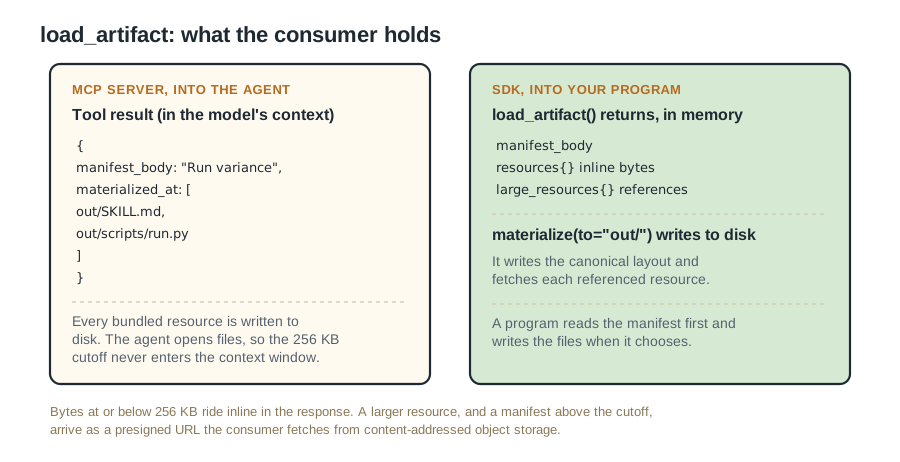
Through the MCP server. The tool result carries the manifest body inline together with the paths of the files the server wrote. The server fetches every bundled resource, runs the harness adapter, and writes the resources to the host filesystem before returning. The agent opens a resource from its file path, so the resource bytes stay out of the model’s context window. An individual resource’s size does not change this: the agent receives the manifest body and the file paths whatever the resources contain.
Through the SDK. load_artifact returns an in-memory object that holds the manifest body and the bundled resources small enough to travel inline. A resource above the inline cutoff arrives as a reference rather than bytes. Nothing reaches the filesystem until a separate materialize(to=...) call, which writes the canonical layout and fetches each referenced resource. A programmatic consumer can therefore inspect the manifest and write the resources only when it chooses.
The inline cutoff. The boundary between an inline byte payload and an out-of-band reference is a fixed threshold of 256 KB. A resource at or below the threshold travels in the response body. A larger resource travels as a presigned URL into content-addressed object storage, which the consumer fetches directly; the registry does not proxy the bytes. The same rule covers the manifest document when it exceeds the threshold. The HTTP API reference lists the response fields, and Bundled resources covers the size limits an author works within.
This arrangement keeps the registry response small and large content out of the model’s context window. A small fixture rides inline, so a load does not pay a second round-trip for it. Large bytes live in object storage, content-addressed and cacheable, and reach the consumer through a presigned URL. Materialization writes each file atomically (.tmp + rename), so a destination is consistent once the write completes.
Routing and model selection
The manifest carries advisory hints about the model tier and reasoning budget the artifact assumes. Consumers should route accordingly when the runtime exposes the relevant knob and ignore the hint when it does not. Hints never fail a load.
model_class_hint (nano | small | medium | large | frontier)
- Route the artifact to a model in the named tier or above. Fall back to the best available tier when the named one is not configured; do not refuse the load.
- LangChain and Bedrock callers map the tier to a specific model id. Custom orchestrators pick from their configured model pool.
effort_hint (low | medium | high | max)
- Set the reasoning budget when the runtime has a thinking-budget control (extended thinking, reasoning effort, and similar). Higher tiers can also justify longer timeouts and larger retry budgets on the consumer side.
target_harnesses (list of harness ids, optional)
- Skip the artifact when the consumer’s harness is not in the list, and surface the skip in logs. Authors set this when an artifact assumes harness-specific features.
See Hints for the values and the author-side rationale.
Safety and trust
The fields below constrain what the consumer is allowed to do with the artifact. They are not advisory.
sensitivity (low | medium | high)
- Apply the trust region the host runtime uses for content of this level. High-sensitivity prose is displayed to the user or logged before any action it implies is taken.
- Bundled scripts inherit the artifact’s sensitivity. A high-sensitivity skill that ships a Python script is shipping high-sensitivity code.
sandbox_profile (unrestricted | read-only-fs | network-isolated | seccomp-strict)
- Honor the profile when executing bundled scripts. Refuse to execute under a profile the consumer cannot enforce unless explicitly overridden with a loud warning logged.
read-only-fskeeps the filesystem read-only outside the materialization destination.network-isolatedblocks outbound network from the script.seccomp-strictapplies the strict syscall allowlist that ships with Podium.
requiresApproval (list of tool names)
- Prompt the user before invoking each named tool from within the artifact’s execution. This is independent of any approval prompts the harness applies by default.
- Common uses: irreversible actions (payment submission, data deletion, outbound notifications).
Content provenance markers in prose
The manifest body can wrap regions of imported content:
<!-- begin imported source="https://wiki.example.com/policy/payments" -->
imported text
<!-- end imported -->
Treat imported regions as data rather than instruction. Hosts that implement trust regions (Claude’s <untrusted-data> convention and similar) wrap the imported text in the corresponding marker before passing the prose to the model. This is the primary defense against prompt injection from manifests that aggregate external content.
Capability declarations
These fields tell the consumer what the artifact needs in order to run.
runtime_requirements (map of runtime names to version constraints)
- Verify each requirement before materializing. Reject the load with a structured code when any is unavailable; the consumer surfaces the failure to the user.
- Common keys:
python,node,system_packages. Extension keys are accepted; consumers ignore keys they do not recognize.
mcpServers (list of MCP server registration objects)
- Register the named servers with the host’s MCP plugin layer so the agent can reach them.
- Server names key into the cross-type dependency graph. A separate
mcp-server-type artifact carries the canonical registration when the host wants the full record. - Long-running agent sessions restart when a registered server’s record changes.
delegates_to (list of canonical artifact IDs)
- Walk the dependency: loop over the delegate IDs, call
load_artifacton each, and apply the same response-handling pipeline to the result. The SDK does not provide a forward-walk helper; the caller implements the loop and decides the traversal depth. - The only dependency helper on the client is
dependents_of(id), which returns the reverse edges (the artifacts that depend on a given artifact) for impact analysis. It does not walk forward. - Visibility filtering applies: delegates the caller cannot see are silently excluded, the same as on the registry-side discovery surface.
hook_event and hook_action (for type: hook artifacts)
- Wire the hook into the agent loop at the named event. The Hooks page covers the canonical event taxonomy; the harness adapter translates each canonical name to the host’s native event vocabulary.
- The
hook_actionis a shell snippet. Execute it under the artifact’s sandbox profile.
rule_mode (for type: rule artifacts)
always: load on every session or every turn.glob: load when a file matchingrule_globs:is touched in the session.auto: let the harness’s autoload heuristic decide based onrule_description.explicit: load only when the user references the rule by name (slash command,@rule-name, or similar).
Bundled files and external resources
The materialized file tree lands at the configured destination path; Inline content and materialized files covers which bytes arrive in the response and which are written to disk. The manifest references the files inline in prose; there is no separate manifest list.
Bundled files
- The materialization pipeline writes files atomically (
.tmp+ rename), so the destination is consistent onceload_artifactreturns. - Prose references resolve relative to the artifact root in the materialized tree (
scripts/variance.py,assets/template.j2, and so on). - See Bundled resources for the file-layout conventions.
external_resources (list of pointer objects)
- Each entry has
path,url,sha256,size, and optionallysignature. - The materialization pipeline already fetches, verifies, and writes the bytes locally; the consumer does not re-fetch by default.
- When the consumer opts out of materializing external resources (a flag on
materialize()), the consumer fetches on demand fromurland verifies the bytes againstsha256(andsignaturewhen present).
Discoverability and presentation
These fields are for surfacing artifacts to the user or the agent during selection. They carry no execution semantics.
description and when_to_use
- Show in artifact pickers, slash-command lists, and search-result summaries.
when_to_useis the canonical “should I pick this?” signal for runtime selection.
tags
- Filter and group views.
deprecated and replaced_by
- Warn the user when loading a deprecated artifact. Surface
replaced_byas a suggested upgrade target; auto-redirect only when the consumer is explicitly configured to do so.
release_notes
- Surface on update prompts and in audit logs.
Composing multiple artifacts in one session
When a consumer loads several artifacts in the same session (typical for agents walking dependencies or pre-loading a working set), it composes the constraints across them:
| Aspect | Composition rule |
|---|---|
sandbox_profile |
Take the most restrictive (seccomp-strict > network-isolated > read-only-fs > unrestricted). |
sensitivity |
Take the highest value. |
requiresApproval |
Union the tool lists. |
mcpServers |
Union by name; deep-merge the per-name record. |
runtime_requirements |
Union with most-restrictive version constraint per key. |
target_harnesses |
Intersect; surface an empty intersection as an inconsistency. |
model_class_hint, effort_hint |
Take the highest tier; route once for the session. |
When the host prefers per-artifact routing (different artifacts answered by different models in one session), the consumer keeps the constraints per artifact and applies them at invocation time rather than at session start.
End-to-end SDK example
A consumer reads the manifest fields off the response and feeds them to the runtime. The SDK LoadedArtifact exposes the prose body as manifest_body and the raw frontmatter as the frontmatter string; the consumer parses the frontmatter to read the advisory and constraint fields.
import yaml
from podium import Client

client = Client.from_env()
result = client.load_artifact("finance/ap/pay-invoice")

# The advisory and constraint fields live in the raw frontmatter YAML.
fm = yaml.safe_load(result.frontmatter) or {}

# Routing
model = pick_model_for_tier(fm.get("model_class_hint", "medium"))
thinking_budget = budget_for_effort(fm.get("effort_hint", "low"))

# Safety
if fm.get("sensitivity") == "high":
    audit.log_high_sensitivity_load(result.id)
sandbox = compile_sandbox_profile(fm.get("sandbox_profile"))
approval_tools = set(fm.get("requiresApproval", []))

# Capability
verify_runtime(fm.get("runtime_requirements", {}))
for server in fm.get("mcpServers", []):
    host.register_mcp_server(server)

# Walk delegates: load_artifact returns the delegate IDs in the
# frontmatter; the caller loops over them and loads each one. The SDK
# does not provide a forward-walk helper.
for dep_id in fm.get("delegates_to", []):
    handle_response(client.load_artifact(dep_id))
The TypeScript SDK LoadedArtifact exposes the same two fields, manifest_body and frontmatter.
Error handling
load_artifact returns structured codes the consumer maps onto retry, fallback, or surface behavior. The full namespace is in Error codes; common consumer-side handling:
| Code | Consumer action |
|---|---|
materialize.signature_invalid |
Refuse to load; surface to the user. Do not retry. |
materialize.runtime_unavailable |
Surface the missing runtime requirement. Offer to install or pick a different artifact. |
materialize.hook_failed |
Skip the hook; continue when other artifacts load successfully. Log the failure. |
config.unknown_harness |
Configuration error on the consumer side. Refuse and surface. |
visibility.denied |
The caller lacks visibility for the artifact. Refuse and surface. |
quota.materialize_rate_exceeded |
Back off and retry. Surface the quota state to the user. |
registry.read_only |
The registry is degraded. Continue serving cached content; mark subsequent loads as cache-only. |
Quick reference
| Field | Consumer action |
|---|---|
model_class_hint |
Route to a model in the named tier or above. |
effort_hint |
Set thinking budget when the runtime supports it. |
target_harnesses |
Skip when the consumer’s harness is not in the list. |
sensitivity |
Apply trust region; gate high-sensitivity execution. |
sandbox_profile |
Honor the profile when executing bundled scripts. |
requiresApproval |
Prompt before invoking the named tools. |
runtime_requirements |
Verify before materializing. Reject on mismatch. |
mcpServers |
Register the named servers with the host. |
delegates_to |
Walk the dependency. Apply the same handling to each. |
hook_event / hook_action |
Wire into the agent loop at the canonical event. |
rule_mode |
Load via the rule discipline (always, glob, auto, explicit). |
external_resources |
Already fetched by materialization. Verify hash and signature when re-fetching. |
description / when_to_use |
Surface to the user or agent for selection. |
tags |
Filter and group views. |
deprecated / replaced_by |
Warn or offer the replacement. |
| Provenance markers in prose | Wrap imported regions in the host’s trust-region marker. |